


Ask anyone overseas what scares them about Australia and snakes will be near the top of the list. Then you arrive, go for a bushwalk, and spend the first hour staring at every stick.
Here's the reality. The Australian Snakebite Project found a median of two snakebite deaths a year between 2005 and 2015, across the whole country.
They're still worth respecting, and a bite is always an emergency. But you only need to know two things: what to do when you see a snake, and what to do if someone gets bitten. Learn the first aid before your first walk, because that's when it matters.
The short version
- If you see a snake, stop, back away and leave it alone.
- Most people are bitten trying to touch or kill a snake, or getting too close.
- Treat every bite as an emergency and call 000.
- Keep the person still and apply a pressure bandage.
- Never wash the bite, cut it, suck it or use a tourniquet.
000emergency number
112mobile backup number
2median deaths a year
What to do if you see a snake

Leave it alone. That's nearly the whole answer.
Queensland's injury surveillance unit says most people are bitten when they try to touch or kill a snake, or move too close to one. Snakes will usually retreat when they get the chance, so give them that chance.
- Stop. Don't run at it, and don't step over it.
- Back away slowly. Give it plenty of room.
- Keep others back. Hold kids and dogs close.
- Go around or wait. Take a wide path, or let it move on.
Heads up: never try to catch or kill a snake, even to identify it. That's what gets people bitten. Hospitals don't need you to bring it in.
How to avoid a bite outdoors

Most of this is simple, and it's worth doing on every walk.
- Wear closed shoes, socks and long pants in long grass
- Stay on the track
- Look where you're putting your feet and hands
- Step onto logs, not over them
- Carry a torch at night
- Don't reach into holes or under rocks
- Carry a snake bandage on bushwalks
In one Northern Territory study, most bites were on the foot or ankle, which is why proper shoes are worth the sweat. Thongs on a bush track are asking for trouble.
Snake bite first aid, step by step
This follows healthdirect and the Australian resuscitation guideline. A bite might not hurt much, and it might leave only faint marks. Treat every suspected bite as an emergency anyway.
- Call 000. Ask for an ambulance. If 000 doesn't work on your mobile, try 112.
- Keep the person still. Keep them calm and don't let them walk. Movement spreads the venom.
- Apply a pressure bandage. Use a broad elastic bandage, 10 to 15 cm wide, over the bite as soon as you can.
- Bandage the whole limb. Wrap from the fingers or toes upward. It should be firm, but you shouldn't be able to easily slide a finger under it.
- Splint the limb. Include the joints on either side of the bite.
- Write down the times. Note when the bite happened and when the bandage went on. Mark the bite site on the bandage if you can.
- Start CPR if needed. Do this if they're unresponsive or not breathing normally.
Do
- Call 000 straight away.
- Keep them still.
- Leave the bite unwashed.
- Bandage and splint the limb.
Don't
- Wash the bite. Venom on the skin can help identify the snake.
- Use a tourniquet.
- Cut the wound.
- Suck out the venom.
- Try to catch the snake.
Top tip: no bandage? Use whatever you've got. Clothing torn into strips is better than nothing. But carry a proper snake bandage in your day pack, as they weigh next to nothing.
Sole Drift app
Get the app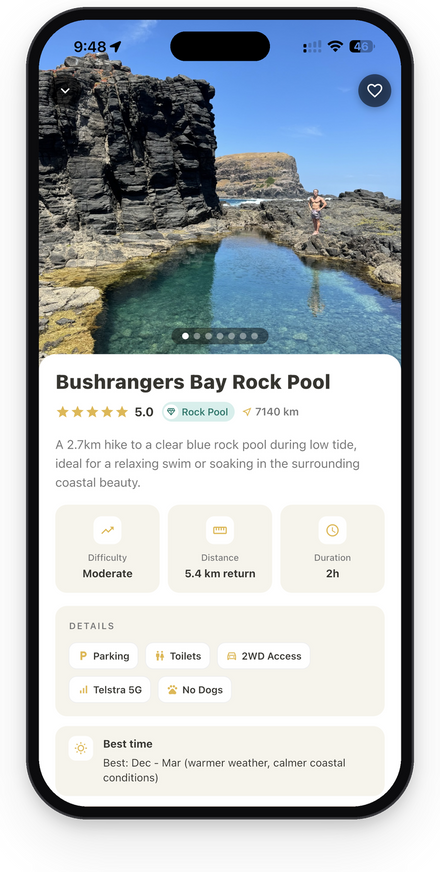
Heading bush? Sole Drift shows phone signal and safety notes for 1,100+ spots across Australia, so you can plan ahead.
What if there's no phone signal?
This is the real risk on a remote walk, because help can be a long way off. Plan for it before you leave.
- Tell someone where you're going and when you'll be back
- Don't walk alone in remote areas
- Carry a snake bandage and know how to use it
- Consider a personal locator beacon for remote trips
- Download offline maps before you go
Stay with the person and keep them still. If you have to leave to get help, make sure they're bandaged first, and mark where they are. Our outdoor safety tips cover more on this, and our camping checklist includes a first aid kit list.
What about spider bites?
Don't use a pressure bandage on a redback bite. It makes the pain worse. Pressure bandages are for snake bites, not all bites, so check healthdirect for anything you're not sure about, or call 000 in an emergency.
Heading further north? Our guide to stinger season and crocodiles covers the risks in the tropics.
Snake bandages are on our list of hiking essentials, along with everything else for a day walk.
Spiders are the other worry on the east coast. Our guide to funnel-web spiders covers where they live and what to do after a bite.
Want the bigger picture? Our guide to the most dangerous animals in Australia covers what actually hurts people, from horses to box jellyfish.
Walking through long grass on the east coast? Our guide to ticks in Australia explains the freeze method for paralysis ticks, and our first aid kit for camping list has the bandages you need for a bite.
Questions people ask
What should you do if you see a snake in Australia?
Stop, back away slowly and leave it alone. Snakes will usually retreat if you give them room.
What is the first aid for a snake bite?
Call 000, keep the person still, and apply a pressure bandage over the bite and the whole limb. Then splint the limb.
Should you wash a snake bite?
No. Venom left on the skin or clothing can help identify the snake.
How many people die from snake bites in Australia?
Very few. The Australian Snakebite Project found a median of two deaths a year between 2005 and 2015.
Should you use a tourniquet on a snake bite?
No. Use a pressure bandage, not a tourniquet.
Respect them, then get on with your walk
Snakes shouldn't stop you enjoying the bush. Wear proper shoes, watch your step and carry a bandage. That's most of it.
This is general information, not medical advice. In an emergency, call 000.
Leave wildlife alone, stay on the track and carry first aid on every walk.