


Every Aussie kid grows up hearing about the redback under the toilet seat. It's practically a national song.
Here's the useful bit the jokes skip. Redbacks live right where campers spend their time: the camp dunny, the folding chair left out overnight, the boots by the tent. And the first aid is the opposite of what you'd do for a snake or a funnel-web.
So this is the practical version for anyone camping, hiking or travelling. What a redback looks like, where it hides, what a bite feels like, the official first aid and when to get help.
The short version
- Redbacks live all over Australia, in dry, sheltered spots close to people.
- Only the female's bite is dangerous, and most bites happen when a hand goes into a web.
- First aid is a wrapped cold pack. Never a pressure bandage.
- Call the Poisons Information Centre on 13 11 26 for advice, any time of day.
- Call 000 if the person collapses, has trouble breathing, or it's a young child with bad pain.
What does a redback spider look like?
Black, shiny and round. The Better Health Channel describes a large, bulbous abdomen, long legs, a red or orange hourglass underneath and, on most, a long stripe along the top.
The female is the one to know. Her body is about 1 cm long, and the Australian Resuscitation Council says the stripe on her back can be red, orange or pale. The male is about 4 mm, much smaller, and usually has no stripe at all.

1 cmfemale body
4 mmmale body
1956antivenom arrives
The web is a giveaway too. It's a messy, tangled web with a thicker, cone shaped retreat at the top where the spider sits, usually built in shade. If you see an untidy web under a ledge with a black spider tucked in the top corner, leave it alone.
Where do redbacks hide at a campsite?
Anywhere dry, sheltered and close to people. The Australian Museum says redbacks favour places near human homes and build in dry, sheltered sites like rocks, logs, sheds and toilets. They don't live in the ground.
They're found right across Australia, though Victoria's Department of Health says they're less common in colder regions. On a camping trip, think about the spots that sit still and stay dry:
- Under toilet seats and around long drop toilets
- Underneath picnic tables and bench seats
- Folding chairs and tables left out overnight
- Boots and shoes left outside the tent
- Stacked firewood and old logs
- Under camper trailer lids, awnings and storage boxes
- Gear tubs, crates and bags left in sheds or under the car

Redbacks aren't aggressive. Better Health says most bites happen when someone accidentally puts a hand into the web, which is exactly what happens when you grab a chair leg or reach under a seat without looking.
What does a redback bite feel like?
It hurts, and it tends to build. The Australian Resuscitation Council lists these signs:
- pain at the bite site, which gets hot, red and swollen
- intense local pain that increases and spreads
- nausea, vomiting and stomach pain
- heavy sweating, especially around the bite
- swollen, tender glands in the groin or armpit of the bitten limb
Better Health and Queensland Health add that the small hairs on the arms or legs may stand on end, and that headache, patchy sweating and muscle weakness or spasms can happen.
How bad does it get? HealthyWA says most bites only cause minor pain and redness. In about 1 in 4 cases, severe pain and other symptoms develop over the first few hours.
Heads up: the Australian Resuscitation Council says a redback bite may threaten the life of a child, though apart from pain it's rarely serious for an adult. Treat any bite on a young child as a reason to get medical help.
Redback bite first aid
Cold, not pressure. This is the bit that catches people out, because you've probably been told to bandage every bite.
Redback bite
- Wash the bite with soap and water.
- Apply a wrapped cold pack.
- No pressure bandage.
- Call 13 11 26 for advice.
Snake or funnel-web
- Call 000.
- Pressure bandage the whole limb.
- Keep the person still.
Here's the official first aid for a redback, from healthdirect, the NSW Poisons Information Centre and the Australian Resuscitation Council:
- Wash it. Clean the bite with soap and water and keep it clean, says healthdirect.
- Cold pack. Put a cold pack or ice wrapped in cloth on the bite to ease the pain. Healthdirect and Better Health say 15 minutes (Better Health says longer if the pain continues). The Australian Resuscitation Council says no longer than 20 minutes at a time.
- No pressure bandage. The NSW Poisons Information Centre says not to apply one.
- Watch the person. Keep them under constant observation.
- Call for advice. Phone the Poisons Information Centre on 13 11 26.
Why no bandage? The Australian Resuscitation Council says the venom acts slowly, and any attempt to slow its movement tends to increase the local pain. Victoria's Department of Health puts it simply: pressure often makes a redback bite hurt more.
Better Health also says never cut the bite or use a tourniquet, and don't give the person anything to eat or drink.

Top tip: if you can catch the spider safely, Better Health says to bring it to the hospital so staff can identify it. A photo on your phone is the safer option. Never try to grab it with your hands.
Our first aid kit for camping guide covers the cold packs and snake bandages worth packing, so you've got the right one for each bite.
When to call 000 or the Poisons line
Know both numbers before you head bush.
Poisons Information Centre, 13 11 26. It's open 24 hours, every day, and gives advice for any bite. The NSW centre says to call it after a redback bite.
000 for an ambulance. Official guidance says to call 000 or get to hospital when:
- the person collapses or stops breathing (HealthyWA)
- you have any concern about their consciousness or breathing (Queensland Health)
- it's a young child, or the pain is severe (Australian Resuscitation Council, which says by ambulance if possible)
The NSW Poisons Information Centre says to go to the nearest hospital if symptoms are severe. Queensland Health says to see a doctor if simple pain relief isn't working, if symptoms spread beyond the bite (like nausea or vomiting), or if you're not sure it was a redback.
Heads up: if you don't know what bit you and it was a big black spider on the east coast, treat it as a funnel-web. The NSW Poisons Information Centre says to call 000 and use a pressure bandage in that case. Our funnel-web spider guide walks through it.
Sole Drift app
Get the app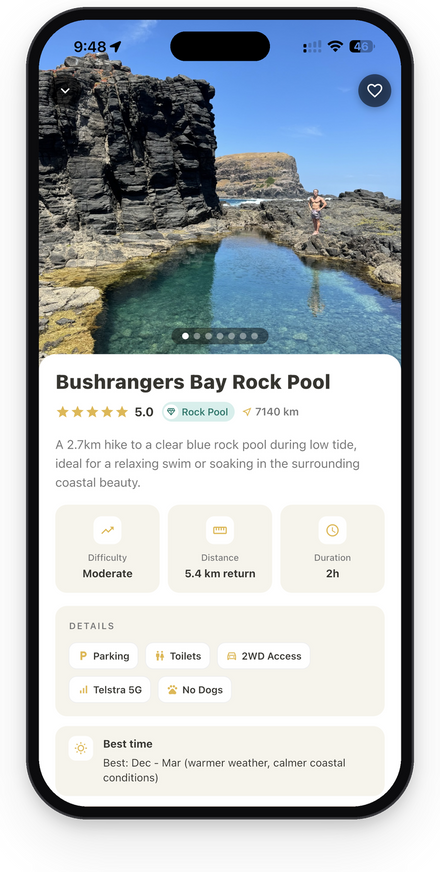
Camping somewhere remote? Each of our 1,100+ spots across Australia shows phone signal and "good to know" warnings, so you know before you go.
Is there redback antivenom?
Yes. Victoria's Department of Health says effective redback antivenom was introduced in 1956, and no deaths have been recorded in Victoria since. The Australian Museum also says no deaths have occurred since antivenom was introduced.
Antivenom isn't automatic, though. The NSW Poisons Information Centre says routine use is no longer recommended, because research shows it has a low response rate. Whether anyone needs it is a call for the doctors at the hospital, which is one more reason to get help when the pain is bad.
How to avoid redback bites when camping
Most of this is habit. A few seconds of looking saves a nasty night.
- Shake out boots, shoes and clothes before you put them on
- Bring shoes and gear inside the tent or car at night
- Look under toilet seats and picnic tables before you sit
- Check chair legs and table edges before you grab them
- Wear gloves when moving firewood, rocks or logs
- Use a stick, not your hand, to check a web
- Keep car windows wound up
- Don't leave clothes lying on the ground
Most of that list comes straight from Better Health and Victoria's Department of Health, with camping swaps where they talk about gardens.

The same habits help with snakes and ticks too. Our guides to snakes in Australia, ticks and the most dangerous animals in Australia cover the rest, and our camping checklist has the full packing list.
Questions people ask
Are redback spiders deadly?
Rarely. Victoria's Department of Health says no deaths have been recorded since antivenom arrived in 1956. The Australian Resuscitation Council says a bite may threaten a child's life, but is rarely serious for an adult apart from the pain.
What do you do for a redback spider bite?
Wash the bite, apply a wrapped cold pack and call the Poisons Information Centre on 13 11 26. Call 000 if the person collapses, has trouble breathing, or is a young child with bad pain.
Should you put a pressure bandage on a redback bite?
No. Official guidance says pressure tends to make the pain worse. Pressure bandages are for snake and funnel-web bites.
How long after a redback bite do symptoms start?
HealthyWA says that in about 1 in 4 cases, severe pain and other symptoms develop over the first few hours. Most bites only cause minor pain and redness.
Do male redbacks bite?
Only the female's bite is dangerous, according to Better Health. The male is about 4 mm long and much smaller than the female.
Look before you reach
Redbacks don't chase anyone. They sit in the dry corners we leave for them, and they bite when a hand lands in the web.
Check the dunny seat, shake your boots and pack a cold pack. This is general information, not medical advice. In an emergency, call 000.
Leave spiders and their webs where they are, and give all wildlife room.