


Ask most people in Britain to picture a squirrel and they'll describe a grey one. Bold, chunky, raiding the bird feeder.
The red squirrel is the native one. It's smaller, it has those tufty ears, and in most of England and Wales it's gone. Grey squirrels have replaced reds across almost all of England and Wales, according to the Wildlife Trusts.
But they're still out there if you know where to look. Here are 9 of the best places to see red squirrels in the UK, covering all four nations, plus when to go, how to spot one and what to do when you do.
The short version
- Scotland holds about 83% of the UK's red squirrels.
- In England they survive in the north, on the Isle of Wight and in Poole Harbour.
- Go in autumn, early in the morning, when they're busy storing food.
- Look for chewed pine cones under conifers and listen for scratching on bark.
- Report every sighting, red or grey, to your local squirrel group.
287,000red squirrels
2.7 milliongrey squirrels
1876first wild greys
How many red squirrels are left in the UK?
Nobody has an exact count. The figure most bodies use is around 287,000, from the Mammal Society's 2018 estimate, which Saving Scotland's Red Squirrels still quoted in June 2026. The UK Squirrel Accord puts greys at over 2.7 million, and even that is thought to be an underestimate.
The Mammal Society lists reds as Endangered in England, Wales and Britain as a whole, and Near Threatened in Scotland. Here's how it breaks down by nation.
| Nation | Where they survive | Roughly how many | Who leads conservation |
|---|---|---|---|
| England | The north (Northumberland, Cumbria, the Sefton Coast), the Isle of Wight and Poole Harbour | 38,900 (2018 estimate, via Natural England, April 2026) | Natural England, with Red Squirrels Northern England and the Wildlife Trusts |
| Scotland | Most of the country north of the central belt, plus pockets in Dumfries and Galloway | About 83% of the UK total (SSRS, June 2026) | Saving Scotland's Red Squirrels, led by the Scottish Wildlife Trust |
| Wales | Anglesey, Clocaenog Forest and the mid Wales forests | Around 700 adults on Anglesey and 100 to 500 in mid Wales (NRW plan review, November 2018) | Natural Resources Wales, Red Squirrels Trust Wales and the Mid Wales Red Squirrel Partnership |
| Northern Ireland | Widespread, strongest in County Down and Fermanagh | No official count. A 2022 survey found reds in about as many woods as in 2017 | The Northern Ireland Squirrel Forum (DAERA) and Ulster Wildlife |
England is the worry. Natural England says reds there have lost as much as 95% of their former range, and modelling for its new recovery strategy suggests they could vanish from mainland England within 25 years if nothing is done.
When is the best time to see red squirrels?
Autumn is the sweet spot. The National Trust says spring and autumn are their busiest seasons, and in autumn they come down to the woodland floor to gather and bury food for winter.
Their ear tufts are at their best from about September too, when the winter coat grows in. That's the easiest way to tell a red from a grey that's caught the light.
Best times
- September to November, when they're caching food
- First thing in the morning
- Later in the afternoon
- January to early spring for mating chases
Harder times
- Midday on a hot day, when they often nap
- Heavy rain or wind, when they stay in the drey
- Busy weekends on the main trails
- Anywhere with a dog off the lead
They don't hibernate, so you can see them all year. Forestry and Land Scotland notes they're active by day but often nap in the afternoon, especially when it's hot.
1FormbyMerseyside
The spotPinewoods behind the dunes, and one of the last red squirrel strongholds in north west England.

The National Trust's Formby reserve is the easiest place in England to see reds from a big city. It's a short train ride from Liverpool, and you can pair the squirrel walk with the beach.
It's also the place that shows how fragile they are. A squirrelpox outbreak in 2008 cut Formby's population by an estimated 80%, according to Lancashire Wildlife Trust.
Heads up: Lancashire Wildlife Trust confirmed squirrelpox on the Sefton Coast again in July 2026 and asked locals to take down feeders. As of November 2026, check the National Trust and the Trust's page before you go, and never feed the squirrels by hand.
2Brownsea IslandDorset
The spotA car-free island in Poole Harbour with Dorset's only red squirrels.
Brownsea is the only surviving red squirrel population in Dorset, says the Wildlife Trusts, with about 200 at the last annual count. Greys never made it across the water.
You get there by ferry, and the National Trust runs it as a seasonal site, so check opening dates and ferry times first. If it's open, autumn is the time to go.
Top tip: the National Trust suggests staying at the island campsite and looking for squirrels once the day visitors have gone. Quiet woods, no queues.
3Isle of Wight
The spotAn island with reds and, thanks to the Solent, no greys at all.

Natural England names the Isle of Wight and Poole Harbour as the only places outside the north where England's reds survive. Hampshire and Isle of Wight Wildlife Trust's Alverstone Mead reserve has a hide in the middle, and Parkhurst Forest and the National Trust's Borthwood Copse are other good woods to try.
The Trust asks visitors not to feed the squirrels, so watch rather than tempt them in.
4Kielder Water and Forest ParkNorthumberland
The spotA huge Northumberland forest and one of England's best-known red squirrel strongholds.
Visit Kielder calls it home to one of the biggest red squirrel populations in the UK, and says autumn is the time to look. Kielder is also a dark sky park, so you can stay for the stars. See our UK dark sky parks guide.
Top tip: Kielder is a big, remote place. Save your maps offline before you set off, and our offline maps guide shows how.
5Whinlatter ForestLake District
The spotA hillside forest above Keswick that doubles as a red squirrel reserve.

The Lake District National Park lists Whinlatter as a Red Squirrel Reserve, where they're actively protected. It also names Burns Wood near Threlkeld, the Borrowdale woods around Derwent Water and Ennerdale.
Forestry England runs guided red squirrel walks from the visitor centre at times, and they book up. If you're heading up there anyway, our Wainwrights guide has easy first fells near Keswick.
Sole Drift app
Get the app
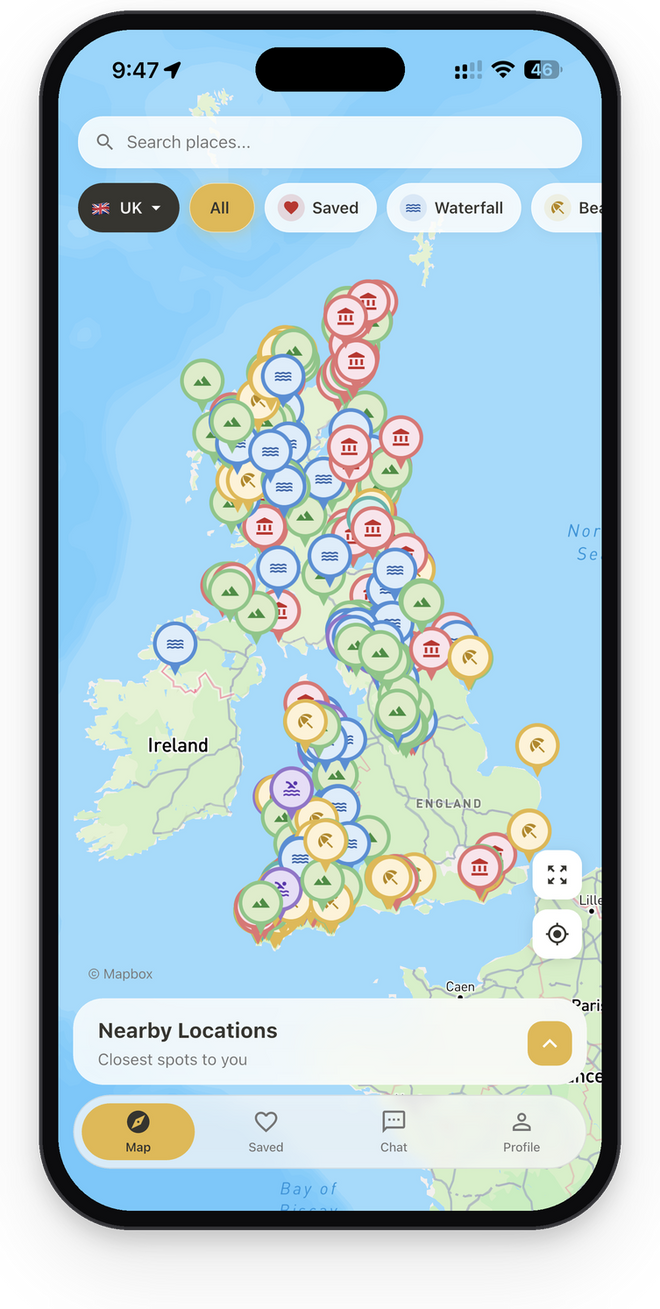
Making a day of it? Sole Drift has waterfalls, viewpoints and wild swims near these squirrel woods, from 500+ spots across the UK.
6Newborough ForestAnglesey
The spotPine forest behind a huge beach on an island where greys were wiped out.
Anglesey is the Welsh success story. Trapping removed greys from the island, and the NRW plan review put the adult red population at around 700 in 2018 after reintroductions.
Newborough Forest is run by Natural Resources Wales, and its forest plan includes managing the woods for red squirrels. The Llyn Parc Mawr area is a favourite for squirrel spotting.
Heads up: keep dogs on a lead in the squirrel woods. A loose dog clears the area in seconds, and reds feed on the ground in autumn.
7Loch GartenAbernethy, Cairngorms
The spotOld Caledonian pine forest where reds share the feeders with crested tits.

RSPB Loch Garten sits inside Abernethy, the largest remaining Caledonian pine forest in Britain. Reds come to the feeders by the visitor centre, so it's one of the few places you can watch them up close without a long wait.
The visitor centre is seasonal, so check opening times. Out of season, nearby Glenmore Forest Park, run by Forestry and Land Scotland, is worth a walk, as reds feed on Scots pine seeds along the trails.
8KirroughtreeGalloway Forest Park
The spotA purpose-built squirrel hide on a short, step-free trail near Newton Stewart.
Forestry and Land Scotland lists the hide at Kirroughtree Visitor Centre, and another at The Lodge Forest Visitor Centre near Aberfoyle, as squirrel-watching spots. Kirroughtree's trail is accessible for buggies and wheelchairs.
It's a good pick for southern Scotland, where Saving Scotland's Red Squirrels says reds are still under threat from greys. Galloway is a dark sky park too, so it pairs well with a night under the stars.
9Tollymore Forest ParkCounty Down
The spotForest and river walks at the foot of the Mournes with a long-running red squirrel group.

Ulster Wildlife lists Tollymore alongside Castlewellan, Glenariff, Slieve Gullion and Florence Court as places to see reds in Northern Ireland. The local Tollymore Red Squirrel Group has worked in the park since 2004, and you'll find the other community groups on the DAERA site.
Heads up: nidirect says squirrelpox has been confirmed in Tollymore since March 2016. If you see a red that looks sick, report it rather than going near it.
How to spot red squirrels
Reds are shy, light and spend most of their time up in the trees. You'll often hear one before you see it.
- Look up into the canopy, not along the path
- Listen for claws scratching on bark
- Check for chewed pine cones on the ground
- Watch for bits of cone falling from above
- Find a hide or feeder and wait
- Stand still and keep quiet
- Bring binoculars
- Look for dreys high up near the trunk
A cone stripped down to the core, with ragged scales around it, is a sure sign squirrels are feeding nearby, says the National Trust. Mixed conifer woods are where they do best.
Top tip: find a hide or feeder, sit down and give it time. You'll see far more sitting still than walking.
Red vs grey, and the squirrelpox story
Greys came from North America in the 1800s, and the first wild population took hold in 1876. They're bigger and they outcompete reds for food.
The real killer is squirrelpox. The Wildlife Trusts explain that greys carry the virus without getting ill, but it's fatal to reds. Infected reds develop sores, often lose their sight and die within about two weeks. Saving Scotland's Red Squirrels says greys can replace reds in an area within 15 years.
Red squirrel
- Smaller, up to about 350 g
- Ear tufts, best from autumn
- Russet coat, sometimes quite brown
- Shy, mostly in conifers
Grey squirrel
- Bigger and stockier
- No ear tufts
- Grey coat, often with a red tinge
- Bold, common in parks and gardens
Some good news: research from Ireland and Scotland, cited in the NRW review, suggests recovering pine martens help reds by keeping grey numbers down.
How to report a sighting
Every record helps conservation groups see where reds are holding on and where greys are moving in. Report greys too, especially in red squirrel areas.
- Note the details. Where, when, how many, and whether it looked healthy.
- Scotland. Use the Saving Scotland's Red Squirrels sightings page.
- Northern England. Report to Red Squirrels Northern England, or Lancashire Wildlife Trust around Formby.
- Wales and the Isle of Wight. Contact Red Squirrels Trust Wales or the Wight Squirrel Project.
- Northern Ireland. Use the Ulster Wildlife sightings form, or report sick squirrels to the NIEA wildlife team.
Heads up: if a red squirrel looks sick, with scabs around the eyes or mouth or acting oddly tame, don't touch it with bare hands. Report it straight away. If you feed garden birds in a red squirrel area, clean feeders daily or take them down during an outbreak.
Want more nature days out? Spring is for the UK's bluebell woods, and our guide to days out near you has ideas for the rest of the year. There are no reds in the Peak District, but it's still one of the best places in England for a long autumn walk, so try our best Peak District walks.
Questions people ask
Where is the best place to see red squirrels in the UK?
Scotland, which holds about 83% of them. In England, try Formby, Brownsea Island, the Isle of Wight, Kielder or Whinlatter.
How many red squirrels are left in the UK?
The usual estimate is about 287,000, from the Mammal Society in 2018. Most are in Scotland, with about 38,900 in England.
What time of day are red squirrels most active?
Early morning and later in the afternoon. They often rest around midday, especially on warm days.
Are there red squirrels in London?
No wild ones. In southern England they only survive on the Isle of Wight and the islands of Poole Harbour.
Why are grey squirrels a problem for reds?
Greys outcompete reds for food and carry squirrelpox, which doesn't harm them but kills red squirrels.
Go early, sit still
Pick an autumn morning, find a pine wood and give it time. Seeing a red squirrel in the wild is one of the best small wins in British nature.
Keep dogs on a lead, never feed them by hand and report what you see. That's how the reds hang on.