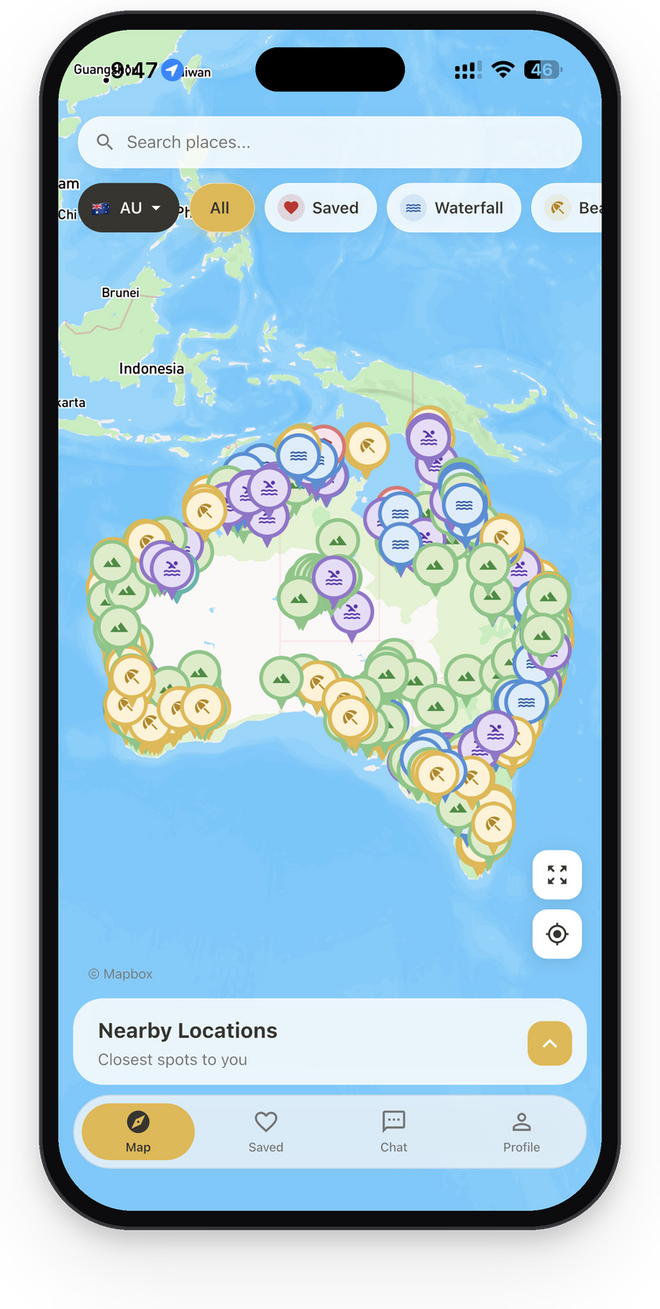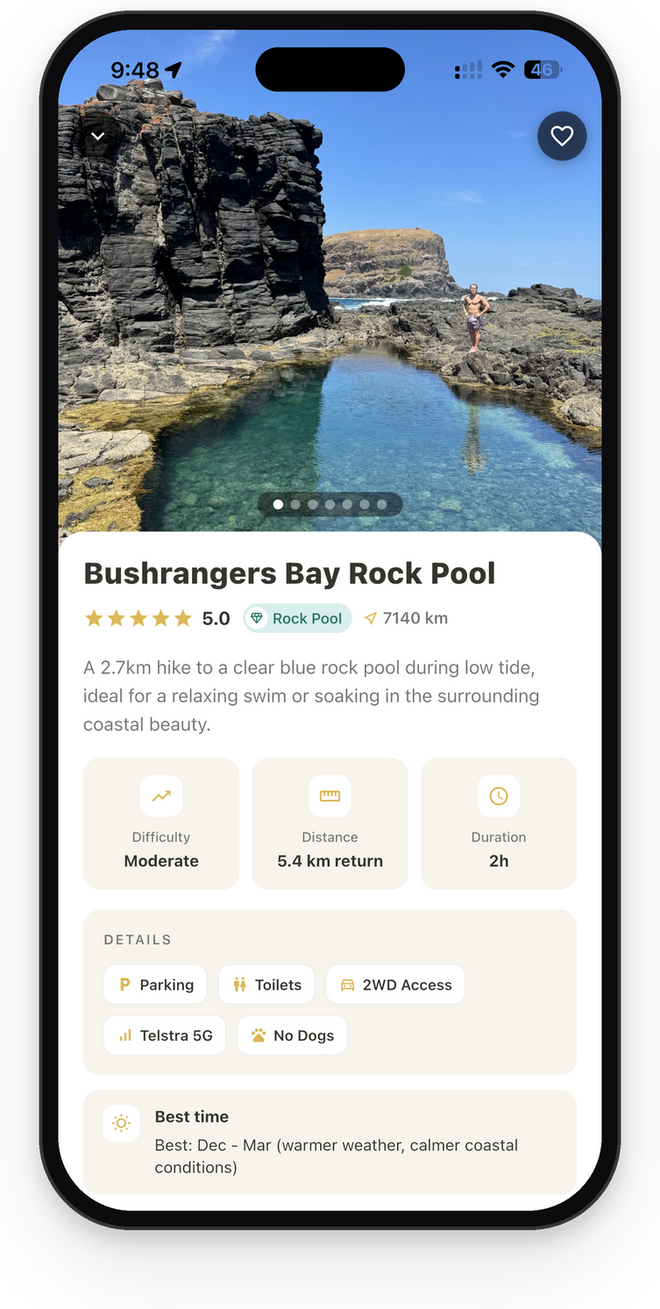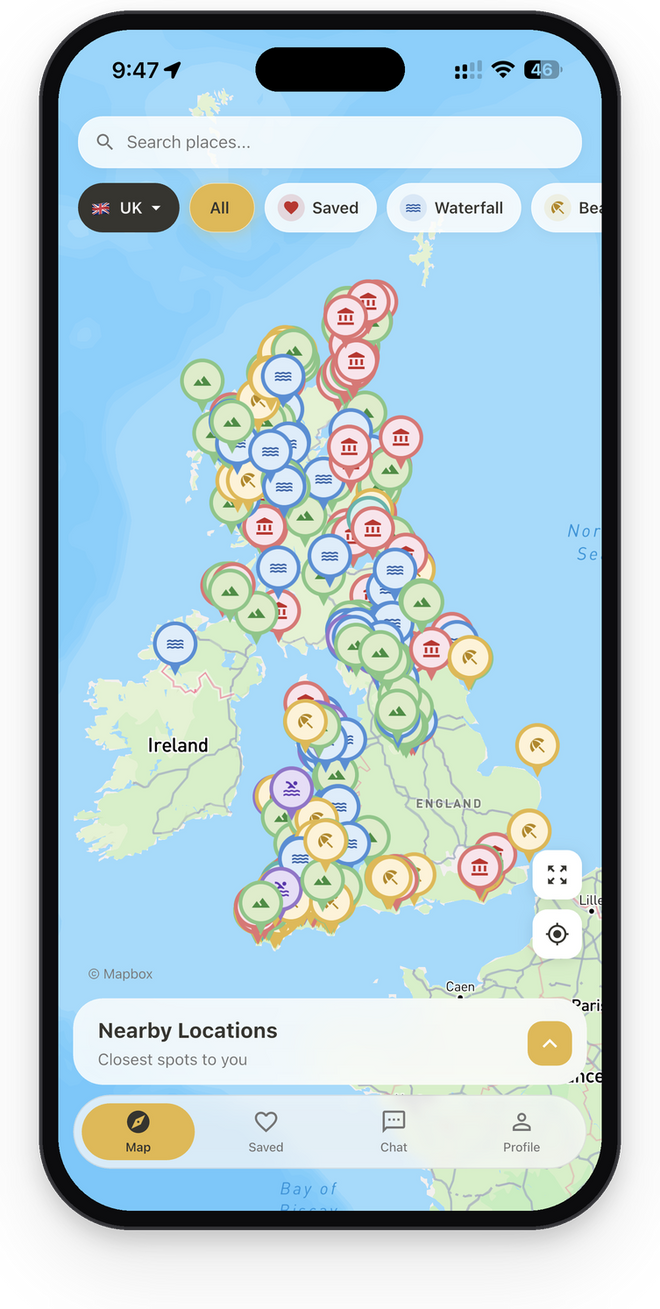



Search "days out near me" and Google hands you the same things every time. A theme park. A zoo. Soft play. A garden centre with a café and a miniature railway.
All fine. All cost a fortune for a family of four.
The best days out in the UK are mostly free and mostly outside: a waterfall after rain, a ridge with a view, a ruined castle you can walk straight into, a beach with nobody on it in October. This guide is how to find those near you, wherever you live, plus the access rules in all four nations and what to check before you leave the house.
The short version
- National parks, National Trails, country parks and most beaches cost nothing to visit. Parking is usually the only bill.
- English Heritage says over 300 of its sites are free to enter, and Cadw, Historic Environment Scotland and Northern Ireland's state care monuments have free sites too.
- Access rules differ: Scotland has a right of responsible access to most land, England and Wales have open access land and rights of way, and Northern Ireland has no general right to roam.
- Check the Met Office, tide times and parking before you go, and keep dogs on a lead near livestock.
- Pick by type: with kids, with a dog, rainy day or by train. Each changes where you should go.
Where do I find free outdoor days out near me?

Start with the big public landscapes, then work down to the small stuff on your doorstep.
- National parks. There are 15 across England, Scotland and Wales, listed on National Parks UK. None charge to get in. Each park authority's website has walks graded by length and difficulty, which beats any listicle.
- National Trails and long distance paths. You don't have to walk the whole thing. Pick a 5 to 8 km stretch near you, especially on the coast. The National Trails site covers England and Wales, and the Wales Coast Path runs 870 miles round the whole Welsh coast.
- National Trust land. The houses charge, but lots of Trust coast, woods and hills are free to walk. You pay for the car park unless you're a member.
- Heritage sites with free grounds. Ruined abbeys, hill forts, stone circles and castle walls. More on these below.
- Country parks and forest parks. Run by councils and forestry bodies, usually with toilets, a café and easy paths. Brilliant with small kids.
- Waterfalls, beaches and viewpoints. These are the bits that make a day feel like a trip, and the bits most "days out" lists skip.
Top tip: open a map, zoom to an hour's drive or train ride from home, and look for green. Woods, commons, moorland and the coast path are almost always walkable, and the quiet ones never show up in a search for "things to do".
The access rules in each UK nation
Where you're allowed to walk depends on which nation you're in. The differences are bigger than most people think.
| Nation | Right to roam? | The rules to know | National parks | Free heritage sites |
|---|---|---|---|---|
| England | On mapped open access land only (mountain, moor, heath, down and registered common), plus public rights of way and the coastal margin | Countryside and Rights of Way Act 2000 and the Countryside Code | 10 | English Heritage says over 300 of its sites are free to enter |
| Wales | Same open access system as England, plus rights of way and the Wales Coast Path | CRoW Act 2000, the Countryside Code and Natural Resources Wales open access guidance | 3 | Cadw runs many unstaffed monuments that are free to wander |
| Scotland | Yes. A right of responsible access to most land and inland water, for walking, cycling and wild camping | Land Reform (Scotland) Act 2003 and the Scottish Outdoor Access Code | 2 | Historic Environment Scotland cares for 300+ properties, and some are free all year |
| Northern Ireland | No general right to roam. Use public rights of way, permissive paths, National Trust land, country parks and forest parks | Access to the Countryside (NI) Order 1983, local councils and the NI Countryside Code | None | 187 state care monuments, many open to visit |
The Scottish Code boils down to three things: respect other people, care for the environment, and take responsibility for your own actions. It doesn't cover houses, gardens or fields with crops growing.
In England and Wales, open access land shows on Ordnance Survey Explorer maps as yellow shading. Off it, stick to the public footpaths and bridleways.
Heads up: Northern Ireland is the odd one out. A path that looks inviting may simply be private. Councils keep the records of public rights of way, and nidirect explains how they work. If in doubt, stick to forest parks, country parks and the Causeway Coast Way.
Fun fact for the walk: open access land in England exists partly because of the Kinder Scout mass trespass on 24 April 1932, when hundreds of walkers went onto the moor above Edale and five were jailed. The Peak District National Park tells the story.
Free heritage sites: the cheapest good day out going

Heritage bodies charge for the big headline places, but a huge number of their smaller sites cost nothing. Think roofless abbeys, Roman forts, hill forts and stone circles, often with a decent walk attached.
- England: English Heritage says over 300 of its sites are free to enter. Filter its map by "free" and you'll likely find one within half an hour of home.
- Wales: Cadw looks after castles, abbeys and burial chambers. Many of the unstaffed ones are open access, and in September its Open Doors festival opens more for free.
- Scotland: Historic Environment Scotland has free sites from Antonine Wall forts to Kilmartin Glen's rock art, alongside ticketed castles like Edinburgh and Stirling.
- Northern Ireland: the Department for Communities cares for 187 state care monuments, from dolmens to castles.
Days out by type
Who you're with changes everything. Here are the main ideas, with a few well-known examples for each.
Days out with kids
Short loops, a café at one end and something to spot. That's the formula.
Tarn Hows in the Lake District has a 1¾ mile circular path round the tarn that the National Trust built to be pushchair and wheelchair friendly (National Trust: Tarn Hows). Formby on the Merseyside coast pairs a big sandy beach with pinewoods where you've a good chance of seeing red squirrels. In Northern Ireland, the Giant's Causeway stones are free to reach on foot along the public right of way; the visitor centre and its car park are what you pay for (National Trust booking page, as of November 2026).
Top tip: give kids a job. A tally of squirrels, a list of five things to find, or the map to hold. A 3 km walk feels half as long.
Days out with a dog
Open hills, forests and quiet beaches outside the summer season are your friends. Cannock Chase in Staffordshire, the Pentland Hills on the edge of Edinburgh and the Mourne Mountains in County Down are all big, free and popular with dog walkers.
Heads up: many councils ban dogs from busy beaches through the summer, often from spring to the end of September. The dates differ beach by beach, so check the council page or the signs. On open access land in England and Wales, dogs must be on a lead from 1 March to 31 July, and near livestock at any time of year.
Rainy day out

Here's the thing about British rain: it's what makes the waterfalls good. A grey day after a wet week is the best time to see one.
High Force in Teesdale drops in one great sheet over a rock step and roars after rain. Raby Estates charges for its woodland path on the north bank (Raby: High Force); the Pennine Way on the south bank is a public footpath. In South Wales, Sgwd yr Eira in Bannau Brycheiniog's Waterfall Country is one of the few falls you can walk behind. In the Lake District, Aira Force has paths and bridges through the woods above Ullswater. For a whole run of falls in one area, our Yorkshire Dales waterfalls guide has seven.
Heads up: wet rock near falls is lethal, and people have died in Waterfall Country. Wear boots with grip, stay behind barriers, and never paddle above a drop.
Days out by train, no car needed
Plenty of the best walks start at a station.
- Edale, Peak District: on the Hope Valley line between Manchester and Sheffield, at the foot of Kinder Scout. Our best walks in the Peak District starts several routes nearby.
- Windermere, Lake District: the branch line from Oxenholme drops you in town, with the lake and short fell walks close by.
- North Berwick, East Lothian: a train from Edinburgh, then a climb up North Berwick Law and a walk on the beach.
- Seaford, East Sussex: the start of the Seven Sisters cliff walk. It's in our day trips from London with six more.
Top tip: look up the last train back before you set off, especially on Sundays and in winter. Rural lines can stop running earlier than you'd think.
Sole Drift app
Get the app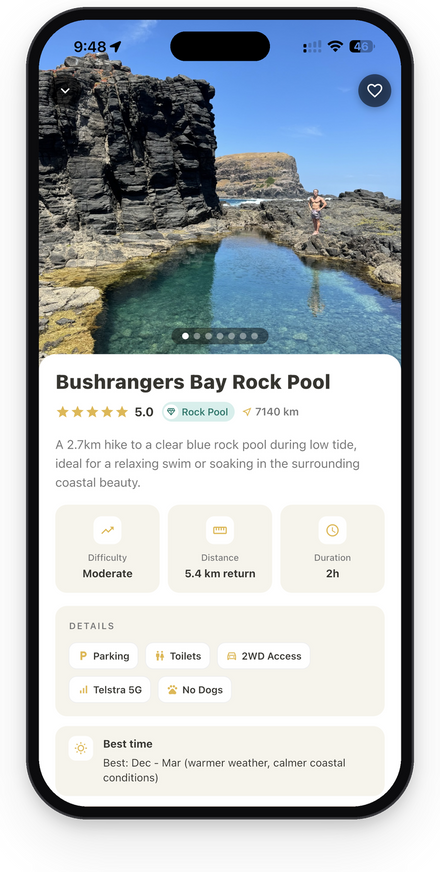
Find waterfalls, coves, viewpoints and ruins near your town, with the walk, parking and dog rules. Sole Drift has 500+ spots across the UK.
How to check before you go

Ten minutes of checking saves a wasted drive, or worse.
- The weather, and the Met Office mountain forecast if you're going up high
- Tide times for any beach, cove or coastal walk, on Admiralty EasyTide
- Parking: is there a car park, does it take cards or an app, and when does it fill?
- Closures on the park, Trust or council page
- Livestock: fields with cows and calves are the ones to avoid
- Toilets and a café, if you've got kids
- Phone signal, and an offline map if it's patchy
- The last train or bus home
Heads up: getting cut off by the tide catches people out every year. Check the times before you walk round a headland, and know your way back off the beach. If you see someone in trouble on the coast, call 999 and ask for the Coastguard (RNLI safety advice).
If cows come at you while you've got a dog, the Countryside Code is clear: let the dog off the lead. It can outrun them, and so can you without it.
On bank holidays and sunny weekends, the famous car parks fill early. Arrive before 9 am, or go after 3 pm when the morning crowd leaves.
Seasonal days out

Spring and summer
- Bluebell woods, mostly in April and early May
- Coast paths and beaches
- Wild swimming on warm days
- Long light for evening walks
Autumn and winter
- Waterfalls in full flow
- Autumn colour in the woods
- Empty beaches with your dog
- Dark skies and stargazing
Spring is short and worth planning for. Bluebells peak for only a few weeks, and our bluebell woods guide has seven of the best. Winter has the longest nights, which makes it the best season for stargazing; the UK's dark sky parks are free to visit, and Malham Cove or Arthur's Seat make a good short winter walk when the light is low.
Want a wildlife day out? Our guide to red squirrels in the UK lists reserves and hides in all four nations.
How Sole Drift helps you find days out near you
Sole Drift is a map of hidden spots: waterfalls, swim holes, beach coves, rock pools, viewpoints, historic sites and wildlife. Search your town and it shows the nearest spots with distances. Each one has the walk distance and time, difficulty, best season, parking, toilets, dog rules, phone signal and a "good to know" warning.
It's built for the "we've got a free Saturday, where shall we go?" moment. Save a few to a list, and you've got a month of days out sorted.
Questions people ask
What are some free days out near me?
National parks, National Trails, country parks, forest parks and most beaches are free to visit. English Heritage says over 300 of its sites are free to enter, and Cadw, Historic Environment Scotland and Northern Ireland's state care monuments have free sites too. Parking is usually the only cost.
Can I walk anywhere in the UK?
Only in Scotland, where there's a right of responsible access to most land and inland water. England and Wales have open access land and public rights of way. Northern Ireland has no general right to roam, so stick to rights of way, permissive paths and public parks.
What can I do outdoors on a rainy day?
Visit a waterfall. Falls like High Force, Aira Force and Sgwd yr Eira are at their best after rain. Wear boots with grip, as wet rock near falls is slippery.
Where can I go for a day out without a car?
Pick a walk that starts at a station. Edale in the Peak District, Windermere, North Berwick and Seaford all have good walking straight from the train.
Do I need to keep my dog on a lead in the countryside?
Near livestock, yes. On open access land in England and Wales, dogs must be on a lead from 1 March to 31 July even without livestock. Many beaches also have summer dog bans set by the council.
Skip the queue at the theme park. Most of the UK's best days out are free, outside and closer than you think.
Leave gates as you find them, take your litter home, and park where you won't block a gateway. The countryside stays open because people look after it.