


Everyone checks the forecast for rain. Hardly anyone checks the fire danger rating.
Then the wind picks up on a 40 degree day, the sky goes orange, and the road you came in on is closed.
Bushfires are part of an Australian summer. You don't have to stay home, but you do need to know how the warnings work and when to change your plans. Here's what to check in every state, using official fire service advice as of November 2026.
The short version
- Check the fire danger rating for where you're going and every area you'll drive through.
- On Extreme days, reconsider travel through bush. On Catastrophic days, leave risk areas early.
- A total fire ban means no fires in the open, including campfires and wood barbecues.
- Download your state's fire app and save the info line.
- Don't rely on your phone, because signal drops out in the bush.
How fire danger ratings work
Australia uses four fire danger ratings. The NSW RFS gives each one a plain instruction.
| Rating | What it means for you |
|---|---|
| Moderate | Plan and prepare |
| High | Be ready to act, and avoid bush fire risk areas if you can |
| Extreme | Take action now, and reconsider travel through bush fire risk areas |
| Catastrophic | For your survival, leave bush fire risk areas |
On days of minimal risk you'll see "No Rating". Catastrophic is the one to take seriously. The RFS says to get to a safer place "early in the morning or the night before", because you may not be able to leave once a fire starts.

Before you go
The RFS's advice for travellers is practical, and most of it takes five minutes.
- Check the ratings. Look at your destination and every area you'll drive through.
- Check for total fire bans. They change day to day.
- Get your state's warnings. Download its app or bookmark its warnings page (see the table below).
- Save the info line. Where your state has one, put it in your phone.
- Download Emergency+. It uses your GPS to help a Triple Zero caller give their location.
- Pack a survival kit. Water, woollen blankets, protective clothing and a battery radio.
Heads up: the RFS warns not to rely on one source of information, "as your phone may not work in a remote area". A battery radio still works when the mobile network doesn't. Our guide to offline maps covers the rest of the no-signal prep.
Where to check, state by state
Every state uses the same four ratings, but each runs its own fire service, warnings and total fire bans. Here's where to look, as of November 2026.
| State | Fire service | Where to check warnings |
|---|---|---|
| NSW | NSW Rural Fire Service | Hazards Near Me app, info line 1800 679 737 |
| Victoria | CFA and Fire Rescue Victoria | VicEmergency app and website |
| Queensland | Queensland Fire Department | Current incidents on the QFD website |
| WA | DFES | Emergency WA website |
| SA | Country Fire Service | Alert SA app, hotline 1800 362 361 |
| Tasmania | Tasmania Fire Service | TFS website, info line 1800 000 699 |
| ACT | ACT Emergency Services Agency | Hazards Near Me app, which the ACT ESA recommends |
| NT | NT Government | SecureNT website |
The season isn't the same everywhere, either. SecureNT says the Top End's bushfire season runs from April to November, and Central Australia's from October to March.
Total fire bans and camping
A total fire ban means "no fires out in the open". That rules out campfires, and any barbecue or pizza oven that burns wood, charcoal or heat beads.
Gas barbecues are only allowed under strict conditions in NSW, such as within 20 metres of a house or in a designated picnic area with an approved appliance. Don't assume your camp stove is fine. Check with the park or forest before you light anything.
Total fire ban
- No campfires
- No wood or charcoal barbecues
- No sparks in the open, like grinding
- Fire permits are suspended
Instead
- Eat cold, or cook in town
- Ask the park about gas
- Keep water handy
- Have a plan to leave
Some parks and forests also ban fires for longer stretches of the fire season, so check the park's alerts page too. Our camp cooking guide has no-fire meal ideas.
Sole Drift app
Get the app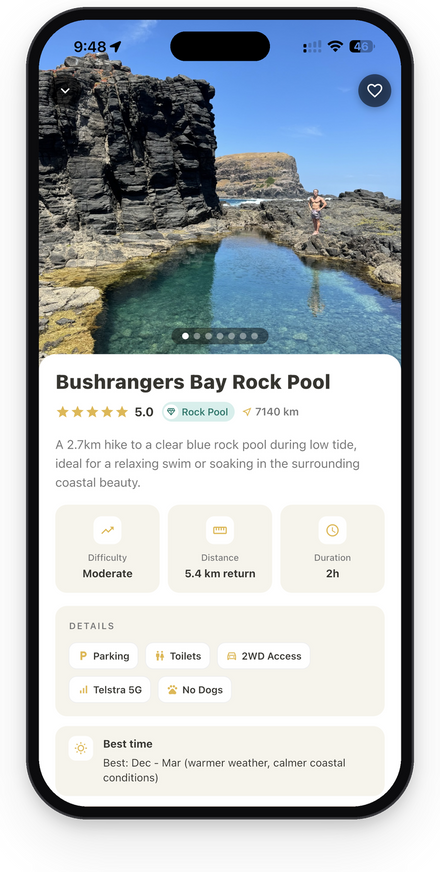
Summer trip? Sole Drift lists access, signal and "good to know" warnings for each spot, with the exact location, from 1,100+ spots across Australia.
If you're caught in a fire in your car

The safest plan is not to be there. The RFS says leaving early is the safest option, and its traveller and camping factsheets are clear that a car is a last resort. If it happens anyway, their advice is:
- Call Triple Zero. If your life is at risk, call 000.
- Pull over in a clear spot. Away from trees, scrub and tall grass.
- Face the fire. Turn the front of the car towards it.
- Seal the car. Close the windows and air vents, and turn on your headlights and hazard lights.
- Get down low. Below the windows, under a woollen blanket, and cover your mouth with a damp cloth.
- Wait. Stay down until the sound of the fire has passed, then get out carefully. The car will be hot.
Top tip: keep a woollen blanket and a few litres of water in the car all summer. They take up no room and could save your life.
Camping in fire season
- Know two ways out. If there's only one road in, think twice on a high fire danger day.
- Check alerts every morning. Ratings are issued daily.
- Tell someone your plans. Especially if you'll be out of signal.
- Leave early, not late. If the rating jumps to Extreme or Catastrophic, pack up the night before.
Our camping checklist and hiking essentials cover the rest of the kit. For when to visit each region, see the best time to visit Australia.
Questions people ask
What are the four fire danger ratings?
Moderate, High, Extreme and Catastrophic. On low risk days there's no rating.
Can you have a campfire on a total fire ban day?
No. A total fire ban means no fires in the open, including campfires and wood or charcoal barbecues.
Should I travel on a Catastrophic fire danger day?
No. The RFS says to leave bush fire risk areas, ideally the night before or early in the morning.
What app shows bushfire warnings?
It depends on the state. NSW and the ACT use Hazards Near Me, Victoria uses VicEmergency and South Australia uses Alert SA.
Change the plan, keep the trip
A bad fire day is a good day for a museum, a beach town or a long lunch. The bush will still be there next week.
Obey fire bans, never leave a campfire unattended and put it out completely with water.