


Type "swimming holes near me" into Google and you get a map full of pins. Some are glorious. Some are closed. A few are places where people have drowned, and nothing on the pin tells you which is which.
This guide is the bit the map leaves out. Where to find good swimming holes near you in Australia, and how to work out, in a couple of minutes on the bank, whether it's safe to get in.
It's written for anyone, whether you've lived here your whole life or you landed last week.
The short version
- Start with official sources: the state national parks site and the local council tell you what's open and where swimming is allowed.
- Check the park alerts and the rain from the last day or two before you leave.
- On the bank, check the depth with a stick, look for logs and rocks, and throw in a leaf to see how fast the water moves.
- Never jump or dive in, and never swim alone.
- North of Gladstone in Queensland, and across the top of Australia, assume crocodiles could be in any water.
How do I find swimming holes near me?
The best way is to start with the people who manage them. Every state has a national parks website that lists swimming spots, track lengths and closures, and local councils look after the creek reserves and waterholes outside the parks.
- National parks: NSW National Parks, Queensland Parks, Parks Victoria, Parks and Wildlife WA, National Parks SA and Parks Tasmania.
- Councils: search the council name plus "swimming" or "waterhole". Council pages often have the things that matter most, like closed areas and cleaning days.
- Google Maps: good for spotting what's around, but treat the pins as a starting point. Read the recent reviews, and check the spot against an official page before you drive out.
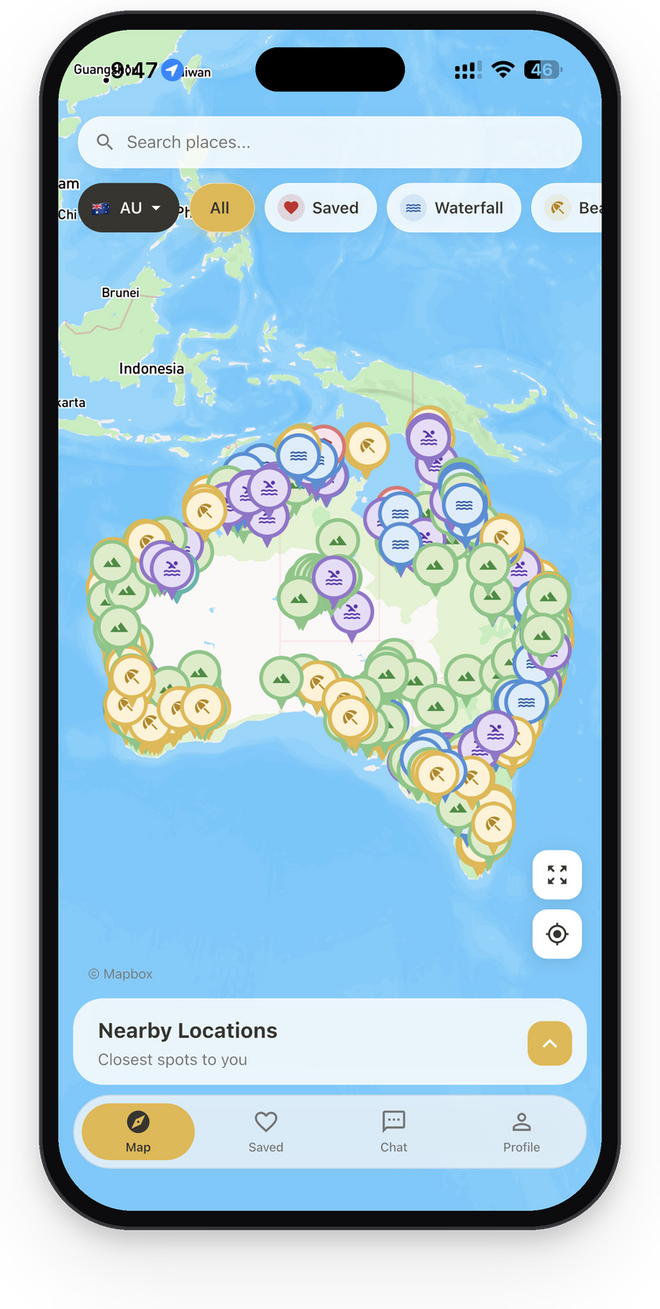
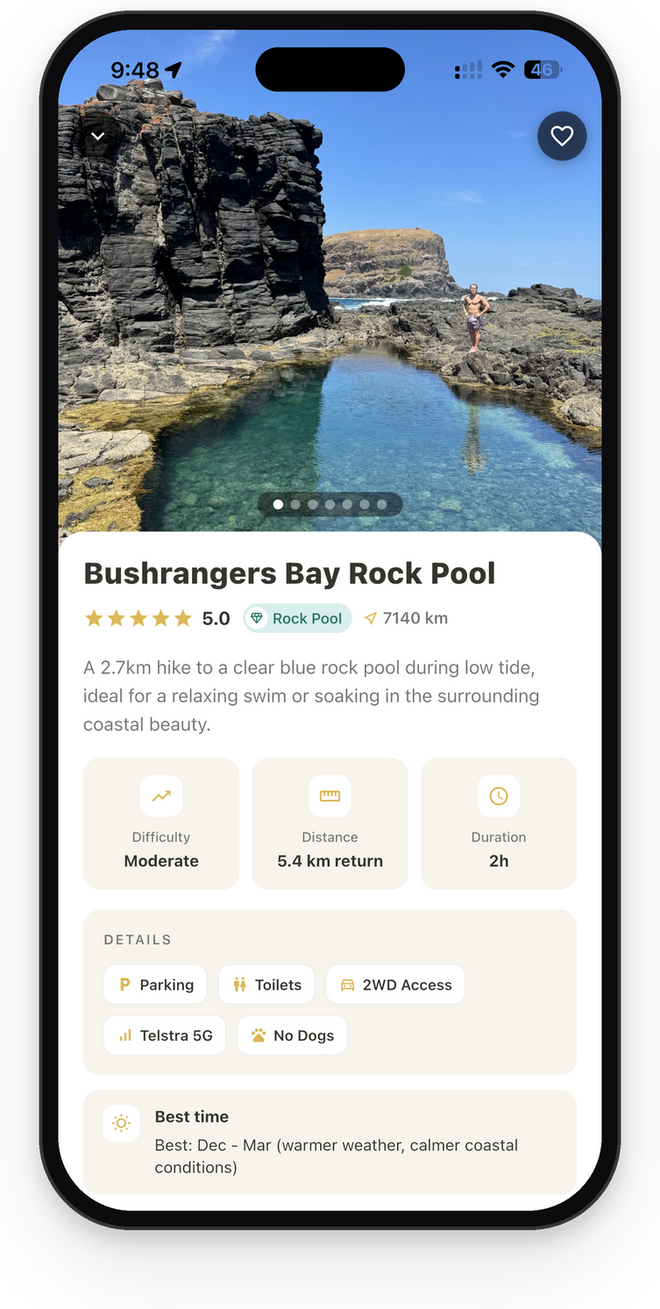
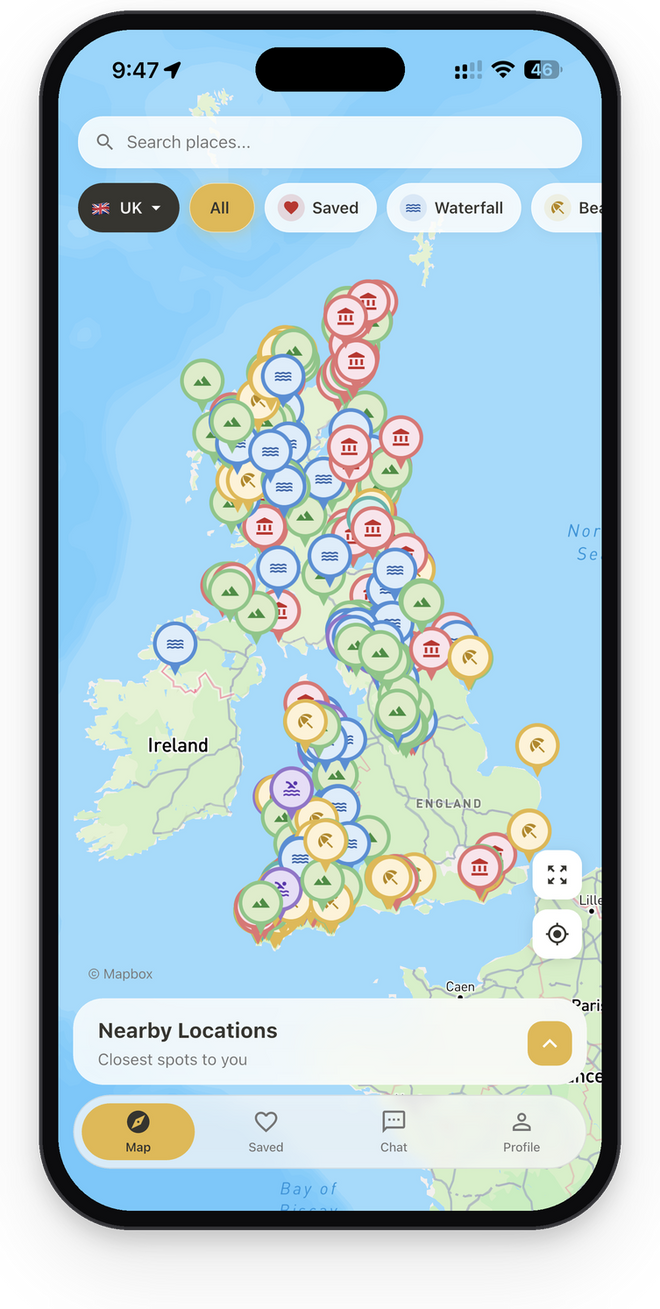
Then there's the shortcut. The Sole Drift app maps 1,100+ spots across Australia, including swim holes, waterfalls and rock pools, and each one shows the walk, the best season, parking, phone signal and a "good to know" warning. You can search any town and see the closest spots with distances.
How do I know if a swimming hole is safe?
Check it twice: once before you leave, and again when you're standing on the bank. Royal Life Saving's advice for rivers and creeks boils down to a few simple checks that take a couple of minutes.
- Before you leave. Check the park or council page for closures, and check the weather for the last day or two. Rain upstream changes everything.
- On the bank, look first. Is the water clear or brown? Is it moving? Can you see logs, branches or rocks under the surface?
- Check the depth. Royal Life Saving suggests using a stick to check how deep the water is and to feel for submerged objects.
- Check the current. Throw a leaf in and watch how fast it travels. If it races off, so would you.
- Get in slowly, feet first. Never jump or dive, even if you've seen someone else do it.
- Know your way out. Before you swim, pick the spot where you'll climb out.
Heads up: still water can fool you. Royal Life Saving warns that a calm surface can give a false sense of security. Some of Australia's deadliest swimming holes look like the calmest. At Babinda Boulders near Cairns, council says 21 people have drowned, mostly in closed areas next to the main pool.
Why are swimming holes riskier than the beach?
Mostly because there's nobody watching. Rivers, creeks and waterholes aren't patrolled, so if you get into trouble there may be no one around to help.
313drowning deaths
90at inland waterways
68in rivers
Those are Royal Life Saving's figures for Australia in its National Drowning Report 2026. Rivers on their own are one of the biggest causes of drowning in the country, and they're exactly where most swimming holes are.
None of that means stay home. It means swim like there's no lifeguard, because there isn't.
When should you stay out of the water?
Some days the right call is a picnic on the rocks instead.
Good to swim
- The water's clear and you can see the bottom
- A leaf drifts slowly
- The park or council says it's open
- It hasn't rained hard for a few days
- You're with someone
Stay out
- The water's brown, fast or higher than usual
- It rained heavily in the last day or two
- There's a closed sign or a fence
- You're in croc country with no sign saying it's a swimming area
- You've been drinking
Top tip: storms in the hills can send water down a creek on a sunny afternoon where you are. If the water starts rising, getting murky or carrying leaves and sticks, get out straight away.
Is the water clean after rain?
Often not. Heavy rain washes runoff into creeks and rivers, and it can carry bacteria. In NSW, the government's Beachwatch service forecasts pollution twice a day for its monitored swim sites, and its advice is to avoid swimming when pollution is likely.
For most bush swimming holes, there's no water testing at all. Give it a couple of dry days after a big storm, and skip it if the water looks or smells off.
What about crocodiles?
In the north, this matters more than anything else on this page. The Queensland Government says croc country starts at the Boyne River, just south of Gladstone, and runs north to the Torres Strait and across Cape York and the Gulf. Crocodiles also live across the top of the Northern Territory and Western Australia.
The Government's Be Crocwise advice is to expect crocodiles in any waterway in croc country, even when there's no sign. Estuarine crocodiles turn up in freshwater rivers and lagoons far inland, and after floods they can appear in places they've never been seen. So in the north, only swim where swimming is clearly signposted and encouraged, and read the signs every visit. The Queensland Government's croc country page has the map.
South of Gladstone, including Brisbane and the Sunshine and Gold Coasts, you're out of croc country.
What to bring to a swimming hole
- Shoes that grip on wet rock
- More water than you think
- A hat and sunscreen (put it on early so it soaks in before you swim)
- A charged phone, and the spot saved offline
- A small first aid kit
- A bag for your rubbish
- A towel and a dry layer
- Snacks for the walk out
Where to start: swimming holes by city
If you want somewhere specific, we've done the research for you in these guides. Each one has the walk in, the official safety advice and what to know before you go.
- Brisbane: 7 swimming holes near Brisbane, from Cedar Creek to a gorge pool under Mount Barney.
- Cairns: 6 swimming holes near Cairns, including the crater lake at Eacham.
- Sydney: waterfalls near Sydney with a couple you can swim under, and the best rock pools in Sydney for ocean swims without the surf.
How Sole Drift helps
Sole Drift was built for exactly this search. Search any town and the app shows the swim holes, waterfalls and rock pools nearby, with distances. Each spot has the walk, the best season, parking, toilets, phone signal and a "good to know" warning, plus the exact location.
When you're heading somewhere without signal, tap Open in Maps on the spot, save it in Google Maps and download the area for offline use before you go. It's free to download, with free spots to try.
Sole Drift app
Get the app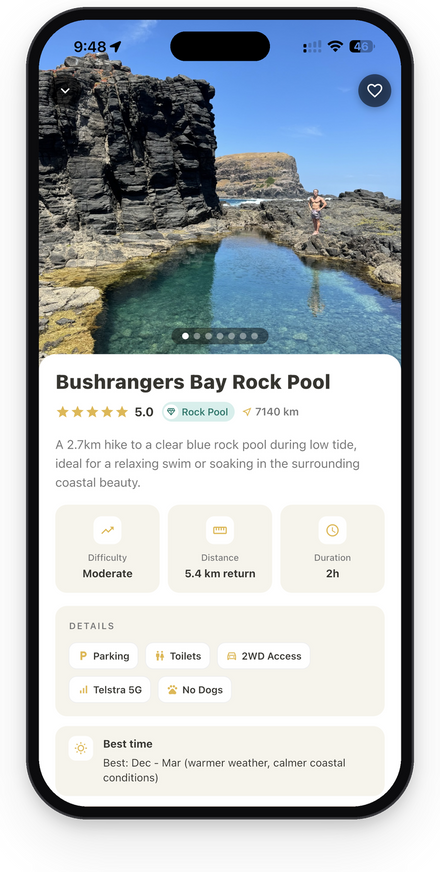
Find the swimming holes near you, with the walk, the parking and the warnings for each one. Sole Drift has 1,100+ spots across Australia.
Questions people ask
Are swimming holes free?
Most are. Some national parks charge a vehicle entry fee, and a few spots near tourist areas charge for a shuttle or parking, but the swim itself is almost always free.
Can you swim at waterfalls in Australia?
At some, yes, and at others it's banned. Always check the park's page: some falls have closed pools or areas where swimming is prohibited with fines.
Is it safe to swim after heavy rain?
Not straight away. Creeks rise fast and can carry bacteria after storms, so wait a couple of dry days and stay out if the water is brown or fast.
Are there crocodiles in swimming holes near Brisbane?
No. The Queensland Government says croc country starts at the Boyne River near Gladstone, well north of Brisbane.
What's the most important safety rule?
Never jump or dive in. Check the depth first, get in feet first, and never swim alone.
Wherever you swim, take your rubbish home, keep sunscreen out of the water where you can, and leave the rocks and plants where they are. Read our Leave No Trace guide and our stay safe outdoors guide before you go. These places stay special because people look after them.