


Everyone sees the Twelve Apostles from a car park. Bus in, walk the boardwalk, bus out.
A few people arrive on foot. They've been walking for a week, from Apollo Bay, through the Otways' tall forest, past the Cape Otway lighthouse, along beaches you can't drive to and down hundreds of steps to shipwreck anchors on the sand.
That's the Great Ocean Walk. Here's how it works: how long it takes, how to book the campsites, which beaches need a low tide, how to get home at the end, and which bits to walk if you've only got a day.
The short version
- It's more than 100 km, one way, from Apollo Bay to the Twelve Apostles.
- The official plan is 8 days, with a hike-in campsite each night.
- Every campsite night must be booked before you walk; the booking is your permit.
- Walk east to west, and plan the beach sections around low tide.
- Carry water treatment: campsite tanks hold untreated rainwater.
100+ kmone way
8 daysofficial itinerary
7hike-in campsites
What is the Great Ocean Walk?
It's a one way, long distance walk along the Otway coast, through Great Otway National Park and Port Campbell National Park. It starts at the Apollo Bay Visitor Information Centre and finishes at the Twelve Apostles.
As of November 2026 the walk is managed by the Great Ocean Road Coast and Parks Authority, which took over from Parks Victoria. The Authority describes it as more than 100 kilometres. You'll also see "about 110 km", which is what older Parks Victoria material and Visit Great Ocean Road quote, once you count the walk into town and the final stretch.
The track changes all day. Fern gullies and tall eucalypt forest, then clifftop heath, then rock shelves and soft beach sand. Expect stairs, long climbs and descents, and sections that turn to mud after rain.

How many days does it take?
The official plan is 8 days. Most stages are 10 to 16 km, so they're not huge, but the hills and sand make them slower than the numbers suggest. Here are the stages with the Authority's figures for each section (one way).
| Day | Section | Distance | Time | Grade |
|---|---|---|---|---|
| 1 | Apollo Bay to Elliot Ridge | 9.8 km | 3h 30m | Medium |
| 2 | Elliot Ridge to Blanket Bay | 12 km | 4h 30m | Easy |
| 3 | Blanket Bay to Cape Otway | 10.5 km | 3h 45m | Easy to medium |
| 4 | Cape Otway to Aire River | 9.6 km | 3h 15m | Medium |
| 5 | Aire River to Johanna Beach | 13.8 km | 5h 15m | Medium |
| 6 | Johanna Beach to Ryans Den | 13.8 km | 5h | Medium to hard |
| 7 | Ryans Den to Devils Kitchen | 12.8 km | 5h 15m | Medium to hard |
| 8 | Devils Kitchen to the Twelve Apostles | 16 km | 4h 45m to Gibson Steps | Easy to medium |
Day 8 runs 14.8 km to Gibson Steps, then on to the Twelve Apostles. Days 6 and 7 are the toughest, and the Authority calls the Ryans Den section remote walking for prepared walkers with a clear plan.
Fit and short on time? The older Parks Victoria FAQ shows a 6 day version that skips the Blanket Bay and Aire River campsites, with two days of around 25 km each. That's a big ask with a full pack.
Which direction?
East to west, Apollo Bay to the Twelve Apostles. The Authority says that's what the walk is designed for: better views, easier gradients, and less crowding on the track and at the campsites. Every campsite booking assumes you're heading west, so walking it backwards gets messy fast.

Booking the hike-in campsites
There are seven hike-in campgrounds: Elliot Ridge, Blanket Bay, Cape Otway, Aire River, Johanna Beach, Ryans Den and Devils Kitchen.
They're small. Each site is about 3.5 m square and takes up to 3 people, so think one small tent. Most campgrounds have eight individual sites (Aire River has six), and the first four also have a group area for up to 18 people. Johanna Beach, Ryans Den and Devils Kitchen have no group area.
- Pick your dates. Work out which campsite you'll reach each night using the stage table above.
- Book each night separately. In the Authority's booking system you add one campground and one night to the cart, go back, and repeat for every night before you check out.
- Keep the booking. It's your camping permit. Camping without one can mean an infringement notice or a fine.
- Register your walk. The Authority asks long distance walkers and groups to register their itinerary at least 14 days before they start.
As of November 2026, campsite fees aren't listed on the Authority's pages; you'll see the price when you book. Weekends in spring and autumn and the school holidays fill first.
Every hike-in campground has a three sided shelter with a table and seating. Elliot Ridge, Cape Otway, Johanna Beach and Ryans Den have two composting toilets; Devils Kitchen has one. Blanket Bay and Aire River have no toilet of their own, but the car campgrounds next door do.
Heads up: campfires aren't allowed at any Great Ocean Walk hike-in campsite. Bring a fuel stove, and on Total Fire Ban days follow the rules for stoves or eat food that doesn't need cooking. Check VicEmergency each morning; parks can close on the worst fire danger days.
Don't fancy carrying a tent? Plenty of people walk it with nights in Apollo Bay, near Cape Otway, around Johanna and at Princetown, using a licensed tour operator or a shuttle to get between the track and their bed.

Water
Each hike-in campground has one or two rainwater tanks, and the Authority lists all of them as untreated. The older Parks Victoria FAQ also says supply isn't guaranteed at these remote sites.
So treat everything (filter, boil or tablets), and carry enough to reach the next sure supply, more on hot days. Food is the same story: Apollo Bay has supermarkets, and after that options are thin. The Cape Otway Lightstation has a cafe, and some tour operators will drop food and water ahead of you.
- Water treatment
- At least 3 litres of water carrying capacity
- Fuel stove (no campfires)
- Small tent for a 3.5 m site
- Waterproof jacket and warm layer, in any season
- Dry bag for river crossings
- Tide times for Apollo Bay and Port Campbell
- First aid kit with snake bandages
- Personal locator beacon
- Bags to carry out every bit of rubbish
Tides, beaches and river crossings
This is the bit that decides your day. Some sections cross beaches, rock platforms and river mouths that the Authority says can become unsafe at high tide or in rough surf. There are inland alternatives in many places, but not all.
Wreck Beach, near Moonlight Head, is the big one. You walk under the cliffs below the high tide mark, past the anchors of old shipwrecks. Parks Victoria recommends walking it only at low tide, and you often can't see the conditions properly from the clifftop before you head down the steps.
Milanesia and Johanna beaches are usually passable in normal tides and calm weather, with about 300 m and 2 km of beach walking respectively. The Elliot, Parker and Johanna rivers have no bridges. They're usually small, but heavy rain plus a high tide and a big swell can make them impassable.
Heads up: tide times on this coast differ by about two hours between Apollo Bay and the Twelve Apostles. Use the Apollo Bay times east of Moonlight Head and Port Campbell times to the west, from the Bureau of Meteorology tide tables. If the water looks deep, fast or wild, wait or turn back. And don't swim: these beaches are unpatrolled and the rips are serious.
Sole Drift app
Get the app
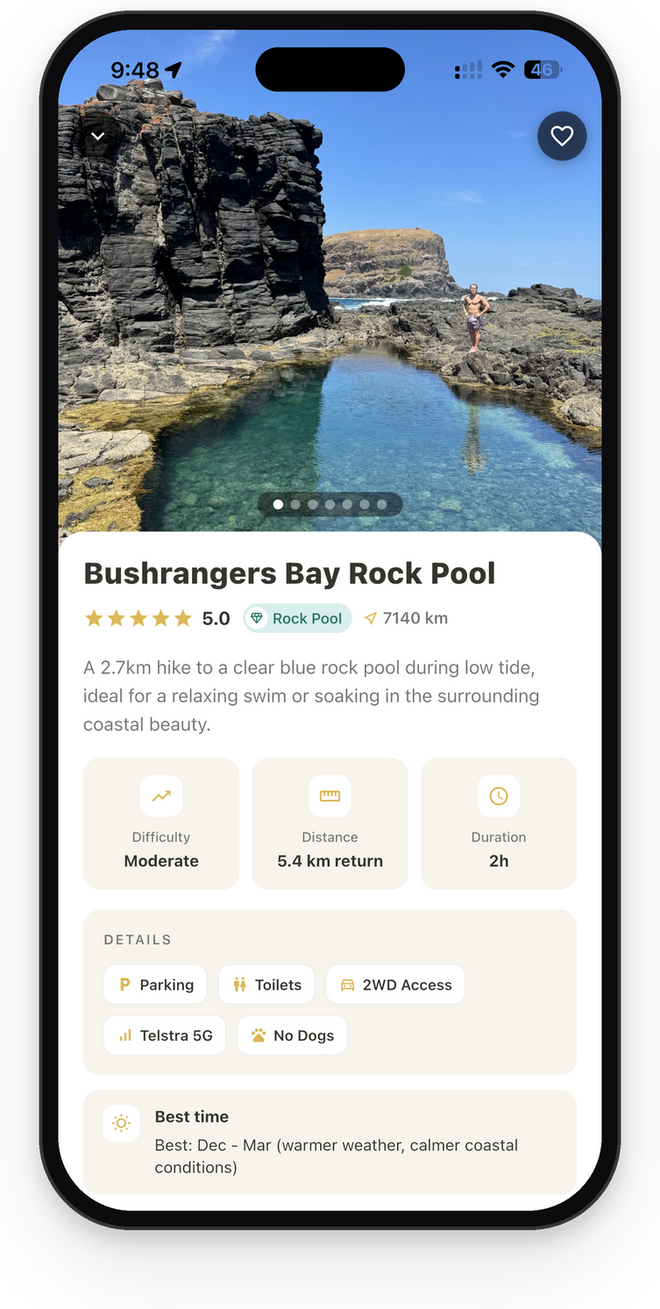
Walking the Great Ocean Walk? Sole Drift has the Otway beaches, lookouts and waterfalls off the track, with exact locations, among 1,100+ spots across Australia.
When to walk it
There's no closed season. You can walk it any time of year if you're prepared for strong winds, heavy rain and both hot and cold days, because the weather on this coast changes fast.
Warmer months
- Longer days for the big stages
- Total Fire Ban days can be declared
- Carry more water
- Snakes are out on the track
Cooler months
- Fewer walkers on the track
- Rain can swell the un-bridged rivers
- Mud and slippery steps
- Bigger Southern Ocean swells on the beaches
Spring to autumn is the busy season, so book early if you're set on those months. Planned burns also happen in autumn and spring, which can close a section at short notice.
Getting to the start and home from the end
The walk is one way, so the car is the problem. The usual fix is to leave your car at the finish and take a shuttle back to Apollo Bay, so you walk towards your car rather than away from it. Visit Great Ocean Road lists licensed operators who run pick ups and drop offs.
Parking at the finish has changed. The new Keerray Woorroong visitor centre at the Twelve Apostles opened on 16 October 2026, and access to the precinct, viewing areas included, is now pre-booked. As of November 2026 bookings are free, with a fee due from April 2027. If you're leaving a car there for the walk, the Authority says to book Great Ocean Walk parking in advance.
No car at all? V/Line coaches run along the Great Ocean Road between Apollo Bay and Warrnambool on some days of the week, with a stop at the Twelve Apostles. Check the current timetable on V/Line before you plan around it, and note coaches don't run on Catastrophic fire danger days.

Best day walks on the Great Ocean Walk
You don't need eight days. Car parks along the coast let you walk it in pieces, and a few short sections cover the best of it.
Marengo to Shelly Beach. A 4.4 km section from the Marengo caravan park, right at the start. Parks Victoria says to take the coastal route only at low tide and in calm seas.
Blanket Bay to Cape Otway. 10.5 km one way, graded easy to medium. Coastal woodland, Parker Inlet, and the Cape Otway Lightstation at the end, which has its own entry fee and a cafe. Koalas are often seen around the Cape Otway campground.
Johanna Beach. A long, wild surf beach on the walk, and one you can also drive to. Walk a stretch of sand and watch the Southern Ocean roll in, but stay out of the water.

Wreck Beach. Over 350 steps down from the Wreck Beach car park to the sand and the old ship anchors. Go at low tide only, and save your legs for the climb back.
Gibson Steps to the Twelve Apostles. The short final stretch of the whole walk. It's the easiest way to finish the way through walkers do, though you'll need a precinct booking to use the viewing areas. Gibson Steps itself is also on our Great Ocean Road itinerary.
Top tip: walk a day section one way and book a shuttle back to your car. It saves walking the same cliffs twice and frees up the afternoon for a lookout or two.
Staying safe on the walk
- Fire. The walk is in a high bushfire risk area with few safe places to shelter. On Extreme or Catastrophic days, leave the park early or don't start. Our bushfire safety guide covers what each fire danger level means.
- Tides. Check both tide tables each morning and time the beach sections for low water.
- Signal. Mobile coverage is patchy, mostly on high points. Download offline maps before you start, and carry a PLB.
- Wildlife. Snakes are active in warm weather, and foxes will raid a badly packed food bag. Don't feed anything.
- Daylight. Walking after dark isn't recommended, so start early on the long days.
Dogs aren't allowed on the national park sections of the walk (registered assistance dogs aside). And as of November 2026 the Authority is asking visitors not to touch sick or dead birds or wildlife because of H5 bird flu; report them on 1800 675 888.

Questions people ask
How long is the Great Ocean Walk?
More than 100 km, one way, from Apollo Bay to the Twelve Apostles, according to the Great Ocean Road Coast and Parks Authority. Some sources quote about 110 km.
How many days does the Great Ocean Walk take?
The official itinerary is 8 days. Fit walkers can do it in 6 by skipping two campsites, with two days of around 25 km.
Do you need to book Great Ocean Walk campsites?
Yes. All seven hike-in campsites must be booked before you walk, one night at a time, and the booking is your permit.
Is there water on the Great Ocean Walk?
The campsites have rainwater tanks, but the water is untreated and not guaranteed. Treat it before drinking and carry extra.
Can you do the Great Ocean Walk in a day?
Not the whole thing, but you can walk single sections as day walks, like Blanket Bay to Cape Otway or Marengo to Shelly Beach.
Start with one day
Walk Blanket Bay to the lighthouse, check the tide, and see if the coast gets its hooks in you. Then come back for the other 90 km. Driving the coast instead? Our Great Ocean Road itinerary covers the stops by car, and our best hikes near Melbourne has shorter walks closer to town.
Book every night, camp only in your booked site, never light a fire and carry out every scrap of rubbish.