


Ask anyone when to go to Darwin and they'll say the dry. May to September. Blue sky, no rain, markets on the beach. Fair enough, they're right.
But here's what surprises people: the temperature barely moves. Darwin's average maximum sits between about 31 and 33 degrees in every single month. What changes is the rain, the humidity, and whether the waterfall you drove two hours to see is open for a swim.
Here's the best time to visit Darwin, month by month, using the Bureau of Meteorology's figures, plus what each season means for Litchfield, Kakadu, crocs and stingers.
The short version
- The best time is the dry season, May to September, with almost no rain.
- October to December is the build-up: hot, very humid and stormy.
- The wet season peaks from about late December to March, with 300 to 430 mm of rain a month.
- Some Litchfield and Kakadu swimming spots close in the wet and reopen after croc surveys.
- Box jellyfish are most likely in the sea from October to the end of May.
The best time to visit Darwin: May to September
Tourism NT puts Darwin's dry season at May to October, with humidity of about 20 to 35% and little or no rain. It says most areas can be easily accessed then. The Bureau of Meteorology's own wet and dry explainer is a touch tighter, calling May to September the dry, with October counted as the start of the build-up.
Either way, June, July and August are the safest bets. Darwin Airport averages under 5 mm of rain in each of those months.
1.0 mmJuly rain
432 mmJanuary rain
1,732 mmyearly rain
That's the whole story in three numbers. July is about as dry as a month gets. January gets about a quarter of the year's rain on its own.

Darwin weather by month
These are the Bureau of Meteorology's long-term averages for Darwin Airport, from records starting in 1941. Max and min are in °C.
| Month | Average max | Average min | Rain |
|---|---|---|---|
| January | 31.8°C | 24.9°C | 432.1 mm |
| February | 31.5°C | 24.8°C | 372.4 mm |
| March | 32.0°C | 24.6°C | 313.1 mm |
| April | 32.8°C | 24.1°C | 102.4 mm |
| May | 32.1°C | 22.2°C | 20.0 mm |
| June | 30.8°C | 20.0°C | 1.8 mm |
| July | 30.7°C | 19.3°C | 1.0 mm |
| August | 31.6°C | 20.4°C | 4.4 mm |
| September | 32.7°C | 23.0°C | 16.7 mm |
| October | 33.4°C | 25.0°C | 69.3 mm |
| November | 33.4°C | 25.4°C | 146.5 mm |
| December | 32.8°C | 25.4°C | 255.5 mm |
Look at the minimums. In July, nights drop to around 19 degrees, which is what makes the dry feel so good. From October to March, it barely gets below 25 even at night, and humidity can top 80% in the wet, says Tourism NT.
Dry season
- May to September, sometimes October
- Almost no rain
- Cooler nights, around 19 to 22°C
- Busiest, so book early
Wet season
- About November to April
- Afternoon storms and monsoon rain
- Hot, humid nights
- Waterfalls at full flow
The dry season (May to September)
This is Darwin at its easiest. Sunny days, dry air and every road open. It's also when the city puts on its outdoor life.
The Mindil Beach Sunset Market runs on Thursdays and Sundays from 4 pm to 9 pm, from the last Thursday of April to the last Thursday of October. Grab food, find a patch of sand and watch the sun drop into the Timor Sea.

Heads up: Mindil is a beach to look at, not to swim at. Saltwater crocodiles can turn up along Darwin's coast, and box jellyfish are most likely in the water from October to May.
The catch with the dry is everyone else. Kakadu's own when to come page calls it the most popular time, with most sites open, and says to book accommodation early. Darwin's hotels and campervan hire fill up in the same months.
Top tip: aim for May or September. You get dry weather and open roads with fewer people than the July school holidays.
The build-up (October to December)
The Bureau describes the build-up as the first few months of the wet, from October to December. Temperature and humidity climb, but rain is very isolated. October and November are Darwin's hottest months on average, at 33.4 degrees, with nights of around 25.
It's sticky, heavy weather. Plan walks for sunrise, carry far more water than you think you need, and book a room with air conditioning.
The upside is the evening light shows. Clouds stack up through the afternoon, and storms often roll in late in the day.
The wet season (November to April)
The wet is when the Top End turns green. The Bureau says the wet runs from October to April and is northern Australia's peak time for rain, severe thunderstorms and tropical cyclones. The monsoon itself usually arrives around late December. The Bureau's long-term average onset date at Darwin is 29 December.
January is the wettest month, with 432 mm on average. By April, rain has dropped to around 102 mm and the waterfalls are still running hard. That makes April and early May a sweet spot for falls, if you're happy with some closures.

Heads up: the tropical cyclone season runs from 1 November to 30 April. In November 2025, Severe Tropical Cyclone Fina formed north of Darwin and brought damaging winds to the city. If you travel in the wet, follow the Bureau's cyclone information and local warnings, and have a flexible plan.
Tourism NT points out that some locals reckon the wet is the best time of all. Harbour cruises and scenic flights run all year, and a flight over Kakadu in the wet shows the waterfalls in full flow when the roads in are flooded. Kakadu passes are cheaper too (see below).
Litchfield and Kakadu by season
This is the part that catches people out. Darwin's day trips depend on the season far more than the city does.
Wangi Falls, Litchfield National Park
The spotA waterfall dropping off the escarpment into a big plunge pool, the classic Litchfield day trip from Darwin.

NT Parks closes the plunge pool to swimming over the wet season, when the water gets too high. It doesn't reopen until levels drop and the pool has been surveyed for crocodiles. On the NT Government's swimming in parks list, Wangi is a dry season only swim.
The walk from the pool climbs through monsoon forest and up stairs to the escarpment. NT Parks lists it at 1.6 km and about an hour, Grade 3, steep in sections. Swimming above the falls isn't allowed.
Where Litchfield National Park, a day trip from Darwin
Difficulty Moderate
Distance 1.6 km return
Duration 1h
ParkingToilets2WD accessNo signalNo dogs
Best time May to August, after the wet for the best flow
Entry NT Parks Pass for interstate and overseas visitors
Official info NT Parks
Exact location In the Sole Drift app
Not every Litchfield swim works that way. The NT list has Florence Falls and Buley Rockhole open all year except in extreme flooding, while Berry Springs, closer to Darwin, is a dry season only swim like Wangi. Florence Falls is also in our guide to waterfalls near me.
Top tip: statuses change quickly after big rain. Check the NT Parks check if a park is open page on the morning you drive out, and only swim where there's a swimming area open sign.
Interstate and overseas visitors need an NT Parks Pass for Litchfield, and it's booked online before you arrive, not at the park.
Sole Drift app
Get the app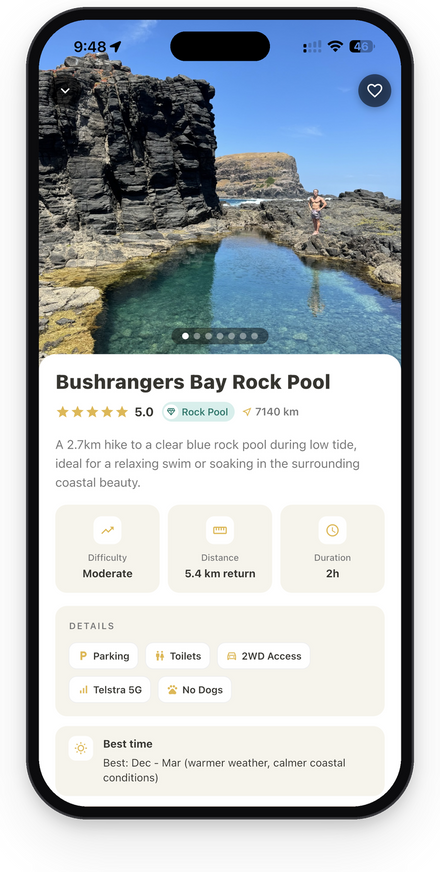
Heading to Litchfield or Kakadu? Sole Drift has the falls and rock holes, with the walk, season and exact location, from 1,100+ spots across Australia.
Kakadu National Park
Kakadu's dry season runs from May to October, when most sites are open, says the park. In the tropical summer, November to April, flooding closes some places, but Burrungkuy (Nourlangie) and Yellow Water stay open all year.
The big one for 2026: Parks Australia says the Jim Jim and Twin Falls area stays closed for all of 2026 while roads are upgraded after cyclone damage, at the request of Traditional Owners. That includes Jim Jim Falls, the Twin Falls gorge and escarpment walk and Karnamarr campground. As of November 2026, it's expected to reopen for the 2027 dry season. Check the Kakadu access report before you plan around it.
As of November 2026, a Kakadu park pass is $25 per adult from 1 November to 14 May and $40 from 15 May to 31 October, valid for 7 days. NT residents get theirs free.
Crocs and stingers: what changes with the season
Neither one goes away in the dry. But both shift with the seasons, and it's worth knowing how.
Box jellyfish. NT Health says box jellyfish are more likely to be in the water from October until the end of May. Stings have been recorded in other months too, so the sea is never fully off the hook. Our guide to stinger season and crocodile safety covers vinegar, nets and stinger suits.
Crocodiles. The NT Government's crocodile safety sheet says wet season flooding, from October to April, links waterways that are cut off in the dry and lets crocs move over a large area. That's why swimming holes close in the wet and get surveyed before they reopen.
Heads up: the NT says to assume any water body in saltwater crocodile range is unsafe unless it's signposted otherwise. No sign doesn't mean safe, and a popular spot isn't proof either.
Pick your month
| If you want | Go in |
|---|---|
| Dry weather and every road open | June to August |
| Dry with fewer people | May or September |
| Waterfalls at full flow, some closures | April to early May |
| Storms, green country and cheaper Kakadu passes | November to April |
| The sunset markets | Late April to late October |
- Book beds and vans early for the dry
- Buy park passes online before you arrive
- Hat, sunscreen and a big water bottle
- Insect repellent for the wet
- Check park status before each day trip
- Download offline maps for Litchfield and Kakadu
Signal drops out fast once you leave town, so set up offline maps before you go. For the rest of the country, see the best time to visit Australia.
Questions people ask
What is the best month to visit Darwin?
June, July or August, when Darwin Airport averages under 5 mm of rain and nights drop to around 19 to 20 degrees. May and September are nearly as dry and quieter.
When is the wet season in Darwin?
Roughly November to April, with the build-up from October. The monsoon usually arrives around late December, and January is the wettest month.
Is Darwin worth visiting in the wet season?
Yes, if you're flexible. You get storms, green country, full waterfalls and cheaper Kakadu passes, but some swimming spots and roads close.
Can you swim at Wangi Falls in the wet season?
No. NT Parks closes the plunge pool when water levels rise and only reopens it after levels drop and a crocodile survey.
When is stinger season in Darwin?
NT Health says box jellyfish are more likely in the water from October until the end of May, though stings have happened in other months.
Dry or wet, just plan for it
Go in the dry for easy days and open roads. Go in the wet for storms and thundering falls. Either way, check the park status before you drive.
Swim only where the signs say it's open, respect closures and Country, and take every scrap of rubbish home with you.